Affiliate Disclosure: To support our research, some links on this site may be affiliate links. If you make a purchase, we may receive a commission at no extra cost to you. We only recommend gear we trust. You can build a custom emergency kit for a personalized plan.
Water Purification Tablets: Which Actually Work? [2026 Testing Guide]
When your city’s water supply fails — whether from a burst main, contamination event, or natural disaster — water purification tablets are the fastest, lightest, and most affordable way to make water safe to drink. But not all tablets are created equal. Some kill bacteria but miss viruses. Others taste terrible. And that expired pack in your emergency kit? It might still work — or it might not. For more details, check out our guide on Portable Water Filters Emergency: Top 5 Compact Purifiers for Urban Survival. You may also find How to Purify Water at Home: 7 DIY Methods That Work in Emergencies helpful. See also our Urban Water & Food Security: Complete Apartment Preparedness Guide.
This guide breaks down the three main types of water purification tablets, compares the top 6 products side by side, and answers the questions urban preppers actually ask — including whether expired tablets are still safe to use. You can calculate your water needs for a personalized plan. You can plan your food storage setup for a personalized plan.
Types of Water Purification Tablets
Water purification tablets fall into three chemical categories, each with distinct advantages and trade-offs. Understanding these differences is critical for choosing the right tablet for your emergency kit.
Iodine-Based Tablets
👉 Build your custom Emergency Kit here
Iodine tablets (like Potable Aqua) have been the military standard for decades. They’re cheap, widely available, and effective against most bacteria and viruses. However, iodine leaves a noticeable chemical taste, doesn’t kill Cryptosporidium, and isn’t recommended for pregnant women, people with thyroid conditions, or long-term use beyond 3 weeks. Treatment time is 30 minutes for clear water, longer for cold or turbid water. The EPA provides additional drinking water safety standards and guidelines.
Chlorine Dioxide Tablets
Chlorine dioxide (ClO₂) tablets like Katadyn Micropur MP1 and Aquamira represent the gold standard for emergency water purification. They kill bacteria, viruses, and Cryptosporidium — the one pathogen iodine misses. The taste is significantly better than iodine, closer to municipal tap water. The trade-off is treatment time: 15 minutes for bacteria/viruses, but a full 4 hours for Cryptosporidium effectiveness. They also cost 2–3x more per tablet than iodine.
Sodium Hypochlorite (NaDCC) Tablets
NaDCC tablets like Aquatabs are the WHO-recommended standard for humanitarian disaster relief. They dissolve fast (under 30 minutes), are extremely affordable in bulk, and are effective against bacteria and viruses. Like iodine, they don’t reliably kill Cryptosporidium. Aquatabs are the most widely used water purification tablet globally — over 1 billion tablets distributed annually in disaster zones.
Top 6 Water Purification Tablets — Comparison Table
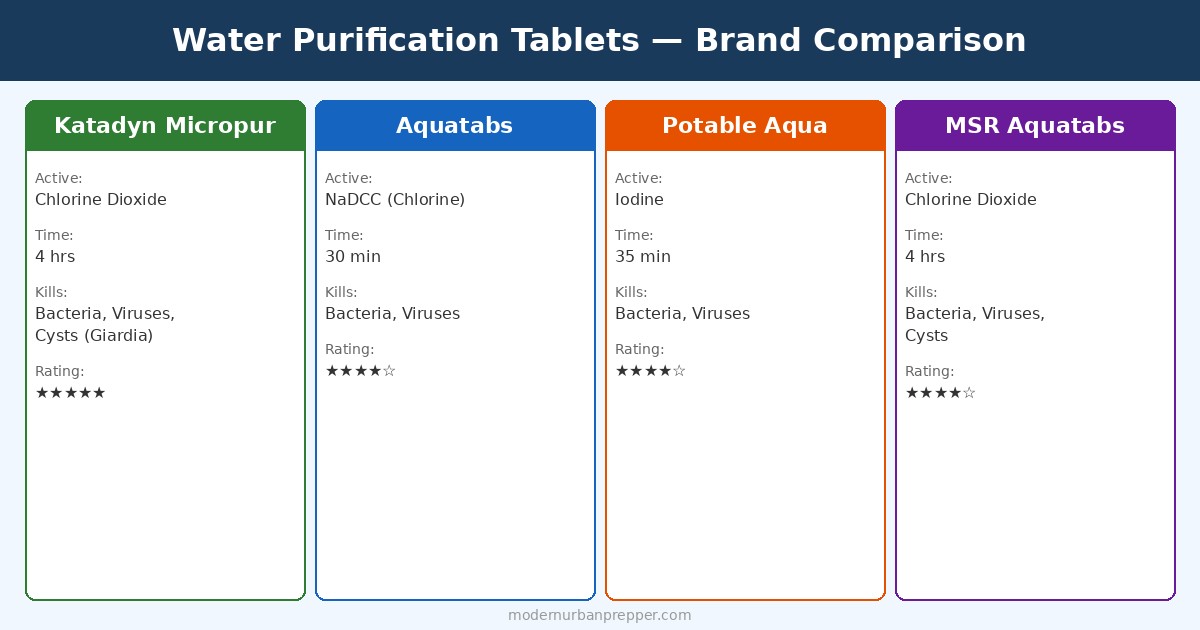
| Product | Active Ingredient | Treats (L/tablet) | Treatment Time | Kills Crypto? | Shelf Life | Price (per tablet) |
|---|---|---|---|---|---|---|
| Katadyn Micropur MP1 | Chlorine Dioxide | 1L | 15 min (4hr for Crypto) | ✅ Yes | 5 years | ~$0.70 |
| Potable Aqua | Iodine | 1L | 30 minutes | ❌ No | 4 years (unopened) | ~$0.20 |
| Potable Aqua Chlorine Dioxide | Chlorine Dioxide | 1L | 30 min (4hr for Crypto) | ✅ Yes | 4 years | ~$0.60 |
| Aquatabs | NaDCC | 1L (49mg) / 20L (167mg) | 30 minutes | ❌ No | 5 years | ~$0.08 |
| Aquamira Water Purifier | Chlorine Dioxide | 1L | 15 min (4hr for Crypto) | ✅ Yes | 5 years | ~$0.50 |
| Coleman Water Purification | Iodine | 1L | 30 minutes | ❌ No | 4 years | ~$0.15 |
Our pick for most urban preppers: Katadyn Micropur MP1 for your primary kit (Cryptosporidium protection matters in urban water sources), plus a bulk pack of Aquatabs as your budget backup supply. This two-tablet strategy gives you both quality and quantity.
In-Depth Reviews
Katadyn Micropur MP1 — Best Overall
The Micropur MP1 is the tablet we recommend for primary emergency kits. Each individually sealed tablet treats 1 liter and remains effective for 5 years in storage. The chlorine dioxide formula handles the full spectrum of waterborne pathogens including Cryptosporidium, which is particularly relevant for urban water sources that may be contaminated by sewage overflow during disasters. The individual foil packaging means you can toss a strip of 30 into a bug-out bag without worrying about moisture degradation. At roughly $0.70 per tablet, it’s the most expensive option — but when you’re purifying questionable urban water, this isn’t where you cut corners.
Aquatabs — Best Budget Option
At $0.08 per tablet, Aquatabs are the most cost-effective way to build a deep water purification stockpile. The 49mg tablets treat 1 liter each, while the larger 167mg tablets handle 20 liters — ideal for family-scale purification. These are the same tablets used by UNICEF, the Red Cross, and WHO in disaster relief operations worldwide. The NaDCC formula dissolves quickly and leaves minimal taste. The limitation is no Cryptosporidium protection, so pair these with a portable filter for comprehensive coverage. A 100-pack costs under $10 and treats 100 liters — enough for one person for over 3 months of drinking water.
Potable Aqua — Military Standard
👉 Calculate exactly how much water you need
Potable Aqua iodine tablets have been the U.S. military’s field water purification standard for decades. They’re effective, proven, and cheap. The main drawback is taste — iodine gives water a distinct medicinal flavor that many people find unpleasant. Potable Aqua sells a companion “PA Plus” neutralizer tablet that removes the iodine taste after treatment. If you go the iodine route, buy the combo pack. Note the important health restrictions: not for pregnant women, people with thyroid conditions, or continuous use beyond 3 weeks.
Aquamira Water Purifier Tablets
Aquamira’s chlorine dioxide tablets offer similar pathogen coverage to Katadyn Micropur at a slightly lower price point. Each tablet treats 1 liter with a 15-minute wait for bacteria/viruses and 4 hours for Cryptosporidium. The tablets come in a compact, resealable pouch rather than individual foil packets, which saves space but means you need to keep the package sealed to maintain shelf life. A solid alternative if Micropur is out of stock.
Are Expired Water Purification Tablets Safe to Use?
This is one of the most common questions we get, and the answer depends on the tablet type and storage conditions. We cover this further in our emergency survival methods.
Chlorine dioxide tablets (Katadyn, Aquamira) in individually sealed foil packets retain effectiveness well beyond their printed expiration date — often 1–2 years past expiry when stored in cool, dry conditions. The foil seal prevents moisture and air degradation. However, once the foil is opened, effectiveness drops rapidly.
Iodine tablets (Potable Aqua) are more sensitive to degradation. Once the bottle is opened and exposed to air, iodine tablets can lose potency within months. Unopened bottles maintain effectiveness through the printed date. If your iodine tablets have turned from gray to yellow or brown, they’ve oxidized and should be replaced.
NaDCC tablets (Aquatabs) in sealed packaging maintain potency for 5+ years. The key factor is whether the packaging seal is intact. Bulk tablets stored in a properly sealed container remain effective well past the printed date.
Bottom line: In a true emergency, expired tablets are better than untreated water. But for your preparedness kit, rotate your supply every 4–5 years. Use our free water storage calculator to determine exactly how many tablets you need, then buy accordingly.
Tablets vs. Filters — When to Use Each
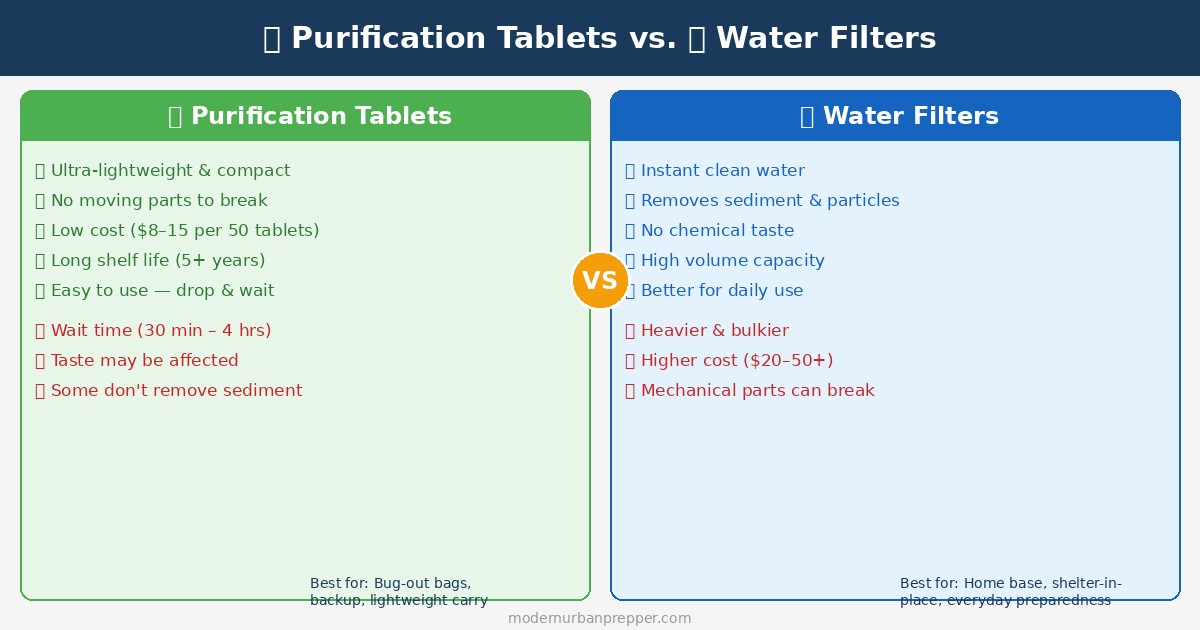
| Factor | Purification Tablets | Portable Filters |
|---|---|---|
| Weight | Ultralight (grams) | Light-moderate (2–12 oz) |
| Cost | $0.08–$0.70/liter | $20–$90 upfront, then free |
| Speed | 15–240 minutes | Immediate (pump/squeeze) |
| Viruses | ✅ Most types kill viruses | ❌ Most filters don’t remove viruses |
| Crypto | ✅ ClO₂ types only | ✅ Most filters remove Crypto |
| Taste | Chemical taste (varies) | Clean, filtered taste |
| Best for | Bug-out bags, backup, lightweight kits | Home base, daily use, groups |
Our recommendation: Carry both. Tablets as your ultralight backup (always in your bag), and a portable filter as your primary purification method at home or base camp. For reusable options, see our portable water filter reviews. For non-tablet methods, see our guide to DIY water purification.
💡 Pro Tip: Not sure how much water your household actually needs? — try our Water Storage Calculator for a personalized breakdown.
How Many Tablets Do You Need?
The standard emergency water recommendation is 1 gallon (3.78 liters) per person per day — half for drinking, half for cooking and hygiene. Here’s what that means for tablet stockpiling:
| Scenario | People | Days | Liters Needed | Tablets (1L each) |
|---|---|---|---|---|
| 72-hour kit (1 person) | 1 | 3 | 11 | 11 |
| 72-hour kit (family of 4) | 4 | 3 | 45 | 45 |
| 2-week supply (1 person) | 1 | 14 | 53 | 53 |
| 2-week supply (family of 4) | 4 | 14 | 212 | 212 |
| 90-day supply (1 person) | 1 | 90 | 340 | 340 |
Use our water storage calculator to get a personalized count based on your household size. Include tablets in your apartment emergency kit as a lightweight backup to stored water.
👉 Make sure your supplies fit your space